

Backlit natural marble and translucent quartzite require controlled slab thickness, verified light transmission, and a properly engineered lighting assembly to achieve uniform illumination. For most commercial feature walls and bar counters, a 6–10 mm stone veneer bonded to a structural backing system offers a practical balance between optical performance, handling strength, and installation weight. However, the correct thickness depends on mineral density, translucency, vein distribution, and the optical properties of the bonding system.
For importers, commercial contractors, and architectural stone distributors sourcing from China, the purchasing specification should define more than slab dimensions and surface finish. Light transmission consistency, resin stability, glass reinforcement, thermal management, and factory inspection procedures must all be verified before mass production.
1. Thickness Calibration for Uniform Light Transmittance
1.1 Why 6–10 mm Is the Main Processing Range
Natural translucent marble and quartzite contain different mineral structures. Their light transmission characteristics depend on mineral composition, crystal arrangement, internal fractures, inclusions, and slab thickness.
Reducing thickness generally increases transmitted light intensity. However, excessive thinning increases the risk of cracking during cutting, polishing, transportation, and installation.
The following table provides practical engineering guidance for initial material selection. These figures are fabrication starting points, not guaranteed optical performance values.
|
Stone thickness |
Typical application |
Engineering considerations |
|---|---|---|
|
6 mm |
Decorative wall panels and small illuminated inserts |
Higher light transmission; requires continuous reinforcement and careful handling |
|
8 mm |
Feature walls and bar fronts |
Practical balance between light transmission and handling strength |
|
10 mm |
Large decorative panels and selected commercial counters |
Greater handling rigidity; requires stronger backlighting |
|
12 mm |
Larger panels requiring additional stone thickness |
Lower transmission; lighting intensity must be reassessed |
For large-format illuminated installations, 8 mm is a reasonable starting specification. A 6 mm panel may be appropriate for highly translucent onyx or selected quartzite, provided that the reinforcement system is designed around the reduced stone thickness.
1.2 Light Transmission Is Not Determined by Thickness Alone
A common procurement mistake is specifying a translucent stone by appearance under normal showroom lighting.
Two slabs from the same quarry can produce different illuminated results because of variations in mineral distribution and internal structures.
The following parameters should be recorded during material approval:
Total stone thickness: 6, 8, or 10 mm.
Light source: LED or fiber-optic system.
Illuminated surface area: measured in m².
Illuminance at the stone surface: measured in lux.
Transmitted luminous flux: measured in lumens where appropriate.
Color temperature: typically 2700K, 3000K, or 4000K.
Local transmission variation: measured across a predefined inspection grid.
For engineering acceptance, the manufacturer and buyer should agree on a reference specimen, lighting configuration, measurement distance, and acceptable variation before production.
A useful comparative inspection method is to divide the illuminated slab into a regular grid and record illuminance at each measurement point. This reveals dark mineral inclusions, resin-filled fractures, and uneven transmission zones.
1.3 Ultra-Clear Tempered Glass Reinforcement and Lamination
Thin natural stone veneer requires mechanical support during transportation and installation.
One possible construction is a composite panel consisting of:
Natural translucent stone veneer.
Optically compatible bonding layer.
Ultra-clear tempered glass backing.
Secondary structural support or mounting frame.
Ultra-clear glass reduces the green tint commonly associated with standard clear float glass. However, glass thickness and construction must be calculated according to panel dimensions, dead load, mounting method, and applicable safety requirements.
|
Component |
Preliminary specification |
Verification requirement |
|---|---|---|
|
Stone veneer |
6–10 mm |
Thickness and visual inspection |
|
Glass backing |
Project-engineered thickness |
Tempering and glass safety documentation |
|
Bonding layer |
UV-stable, optically compatible adhesive |
Adhesion and yellowing evaluation |
|
Composite assembly |
Project-specific |
Load, impact, and handling assessment |
For overhead installations or large suspended panels, the glass backing and mechanical retention system must be independently engineered. Adhesive bonding alone should not be treated as the sole safety restraint.
The assembly should also be evaluated for differential thermal expansion and compatibility between the stone, adhesive, and glass.
1.4 CNC Water-Jet Cutting and Edge Processing for 6–10 mm Veneer
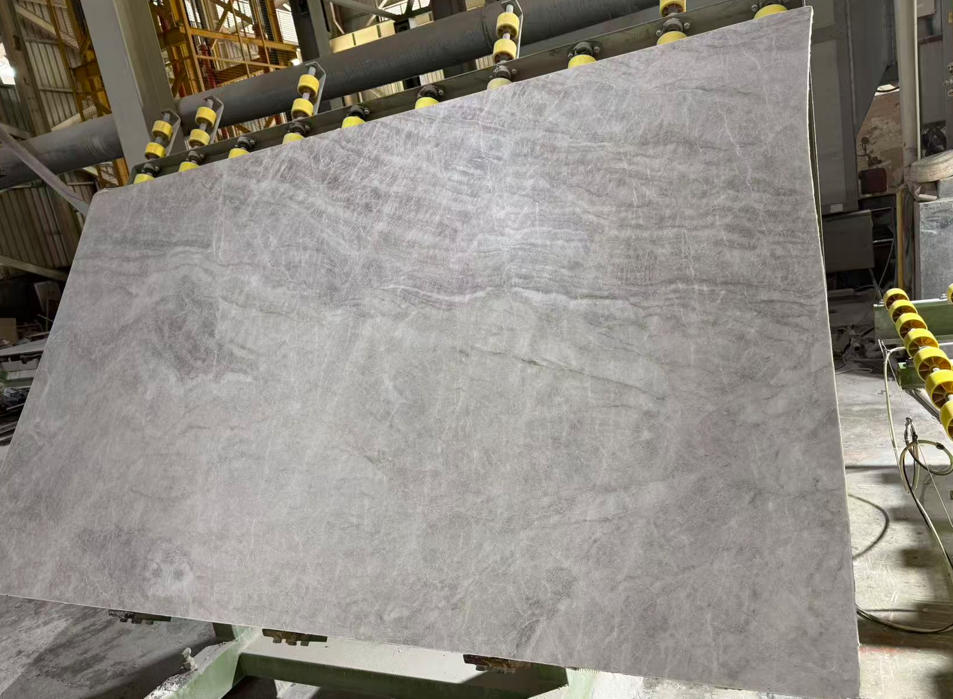
Thin translucent stone is sensitive to localized mechanical stress.
At Yongfeng Stone, production planning for thin stone panels should consider the following processing controls:
CNC water-jet cutting for complex profiles and internal openings.
Infrared cutter processing for straight dimensional cuts where suitable.
Reduced cutting feed rates according to stone characteristics.
Continuous support beneath thin panels during cutting.
Controlled edge grinding to prevent micro-chipping.
Inspection of natural fissures before final sizing.
Water-jet pressure, cutting speed, abrasive concentration, and nozzle distance should be established through trial processing for each stone type. A single machine setting should not be applied indiscriminately to all translucent materials.
Need consistent 8 mm translucent stone panels for a commercial lighting project?
2. Fiber-Optic and LED Light Source Heat Management
2.1 LED Heat Generation and Thermal Expansion
LED systems generate less radiant heat than many conventional lighting technologies, but they still produce heat through electrical losses and thermal resistance.
In an enclosed illuminated stone assembly, insufficient heat dissipation can increase the temperature of the backing plate, adhesive, stone veneer, and surrounding frame.
The resulting temperature changes may contribute to:
Differential thermal expansion.
Adhesive softening or degradation.
Resin discoloration.
Localized stress around stone fissures.
Bond failure between stone and glass.
Changes in the optical appearance of the finished panel.
The coefficient of thermal expansion (CTE) varies between stone types.
Typical approximate reference ranges are shown below. These are indicative material ranges, not certified values for a specific quarry lot.
|
Material |
Approximate linear CTE (10⁻⁶/K) |
Engineering consideration |
|---|---|---|
|
Granite |
6–10 |
Mineral composition affects movement |
|
Marble |
4–8 |
Calcite distribution influences expansion |
|
Quartzite |
7–13 |
Quartz-rich structures may show directional variation |
|
Soda-lime glass |
8–10 |
Must be assessed against the stone and adhesive assembly |
For a 1,000 mm panel subjected to a 30°C temperature increase, a material with a CTE of 8 × 10⁻⁶/K would expand approximately 0.24 mm.
This movement is small in isolation but can become significant across large composite panels, especially where rigid adhesive layers and restricted mounting conditions are involved.
2.2 Selecting Adhesives and Resin Systems for Long-Term Stability
The adhesive used in illuminated stone assemblies must satisfy both mechanical and optical requirements.
Standard stone epoxy is not automatically suitable for backlit applications. Some conventional formulations develop a yellow or amber appearance after prolonged UV and thermal exposure.
Procurement specifications should address:
Initial color and transparency.
UV resistance.
Thermal aging performance.
Adhesion to natural stone.
Adhesion to glass.
Elasticity after curing.
Moisture resistance.
Compatibility with the stone's mineral composition.
For transparent composite panels, the adhesive should be tested on an actual stone sample rather than approved using a generic product datasheet alone.
A practical qualification process includes accelerated UV exposure, thermal cycling, adhesion testing, and visual comparison against an unexposed control sample.
The acceptance limits should be established in advance using an agreed color-difference measurement method, such as CIE L*a*b* and ΔE.
2.3 LED Configuration and Optical Uniformity
The distance between the LED source and stone surface determines how evenly the illuminated field appears.
Insufficient spacing can produce visible LED hotspots, while excessive spacing increases cabinet depth and may require additional lighting output.
|
Lighting configuration |
Typical application |
Main consideration |
|---|---|---|
|
LED light panels |
Large feature walls |
Uniform illumination across broad surfaces |
|
LED strip arrays |
Bar fronts and cabinetry |
Strip spacing and diffuser design |
|
Fiber-optic lighting |
Selected decorative installations |
Light-source accessibility and fiber routing |
|
Modular LED modules |
Replaceable commercial systems |
Maintenance access and driver replacement |
For commercial projects, the lighting designer should provide a mock-up before final production.
The mock-up should use the actual stone slab, backing material, adhesive, LED source, diffuser, and frame depth.
A sample approved under one lighting arrangement should not automatically be considered approved for another arrangement.
2.4 Thermal Management Requirements for Enclosed Backlit Assemblies
An illuminated stone cabinet should not be designed as a completely sealed cavity without thermal assessment.
Recommended design provisions include:
Heat dissipation channels behind the LED modules.
Adequate ventilation where the enclosure design permits.
Accessible LED drivers.
Temperature monitoring during prototype operation.
Expansion allowance at panel edges.
Separation between high-temperature electrical components and stone adhesive joints.
The maximum operating temperature should be specified by the LED and adhesive manufacturers.
For a large commercial installation, a continuous operating test should be conducted on a representative prototype before the full order enters production.
Prevent adhesive discoloration and heat-related failures before mass installation.
3. Vein Continuity Inspection on Illuminated Inspection Racks
3.1 Why Normal Surface Inspection Is Insufficient
Translucent stone must be inspected under two different conditions:
Reflected-light inspection under normal factory lighting.
Transmitted-light inspection using a dedicated illuminated inspection rack.
Reflected light reveals surface scratches, polishing defects, resin marks, and visible fissures.
Transmitted light reveals internal mineral distribution, uneven translucency, hidden fractures, and areas where the stone may produce undesirable dark or bright patches after installation.
A slab that appears uniform under normal lighting may show significant visual differences when illuminated from behind.
For this reason, translucent stone inspection should be performed under controlled backlighting before final approval.
3.2 Illuminated Inspection Rack Configuration
A dedicated inspection rack should provide stable support and consistent illumination across the entire slab.
The rack should include:
A flat or appropriately angled support surface.
Diffused LED lighting.
Adjustable illumination intensity.
Consistent color temperature.
Electrical protection for workshop conditions.
A defined distance between the light source and stone.
A measurement grid for recording light distribution.
The inspection team should photograph each slab under identical lighting conditions.
For wholesale orders involving multiple slabs, the factory should maintain individual slab identification records linking the inspection photographs to the production batch.
3.3 Book-Matching and Vein Continuity Control

Book-matching is frequently specified for translucent marble feature walls, reception counters, and commercial bar installations.
The process involves opening adjacent slabs from the same block in sequence so their natural veins form a mirrored pattern.
However, visual continuity under reflected light does not guarantee continuity under transmitted light.
Differences in mineral concentration and internal crystal structure may create contrasting illuminated zones.
A recommended production workflow is:
Select slabs from the same block or compatible block sequence.
Identify the natural vein direction.
Arrange the slabs in the proposed installation sequence.
Conduct reflected-light visual inspection.
Conduct transmitted-light inspection.
Photograph the full arrangement.
Mark each panel with its installation position.
Record the approved layout before cutting.
Dry-lay inspection should be completed before the panels are packed.
For large commercial feature walls, this procedure reduces the risk of installing visually incompatible slabs next to one another.
3.4 Mineral Inclusion and Natural Fracture Assessment
Natural translucent stone contains mineral variations that cannot be eliminated through mechanical processing.
The inspection team should distinguish between acceptable natural characteristics and defects that affect structural integrity or visual performance.
|
Inspection item |
Evaluation method |
Procurement decision |
|---|---|---|
|
Mineral inclusions |
Transmitted-light inspection |
Assess visual impact |
|
Natural veins |
Reflected and transmitted light |
Approve pattern continuity |
|
Open fissures |
Visual and physical examination |
Repair or reject according to specification |
|
Resin-filled areas |
Backlighting and surface inspection |
Verify color stability |
|
Thickness variation |
Caliper or thickness gauge |
Compare with agreed tolerance |
|
Edge micro-cracks |
Magnified visual inspection |
Reprocess or reject where necessary |
Thickness tolerance should be agreed according to the selected stone, processing method, and final panel assembly.
For precision composite panels, a proposed target of ±0.5 mm may be evaluated for suitable production conditions. This is a project-specific target, not a universal tolerance for all natural stone.
3.5 Factory Quality Control and International Testing References
The following standards and methods can support the quality-control framework for natural stone procurement.
|
Standard |
Test or application |
Relevance to procurement |
|---|---|---|
|
ASTM C97/C97M |
Absorption and bulk specific gravity |
Physical characterization |
|
ASTM C99/C99M |
Modulus of rupture |
Flexural performance |
|
ASTM C880/C880M |
Flexural strength |
Bending performance |
|
ASTM C1354/C1354M |
Anchorage strength of dimension stone |
Mechanical fixing assessment |
|
EN 1469 |
Natural stone slabs for cladding |
Product requirements |
|
EN 12372 |
Flexural strength under concentrated load |
Mechanical assessment |
|
EN 13755 |
Water absorption at atmospheric pressure |
Moisture performance |
|
ISO 9001 |
Quality management systems |
Production process control |
These standards do not directly establish a universal light-transmission rating for translucent marble.
Optical acceptance criteria should therefore be defined through a separate project-specific inspection procedure.
3.6 Production Traceability from Blocks Yard to Finished Panels
For large-volume procurement, the inspection record should begin before slab processing.
A reliable production traceability system should connect:
Blocks yard identification.
Block number and quarry origin.
Slab cutting sequence.
Slab thickness measurements.
Resin treatment records.
Book-matching sequence.
Illuminated inspection photographs.
CNC water-jet cutting records.
Final panel dimensions.
Packing identification.
This is particularly important when an order includes multiple containers or requires additional panels several months after the initial shipment.
Using a recorded block and slab selection sequence reduces the risk of substantial visual differences between replacement panels and the original installation.
4. Export Packaging and Installation Risk Control for Backlit Stone Panels
4.1 Seaworthy Wooden Crates for Thin Composite Stone
Thin translucent stone panels are more vulnerable to impact and vibration than conventional thick stone slabs.
Packaging should account for the combined weight and mechanical characteristics of the stone, glass backing, and adhesive assembly.
Recommended packaging provisions include:
Seaworthy wooden crates with appropriate structural strength.
Individual protective separation between panels.
Non-abrasive contact materials.
Rigid edge protection.
Anti-vibration support.
Moisture-resistant internal protection.
Clear orientation and handling labels.
Appropriate lifting points and center-of-gravity markings.
The packing design should prevent direct contact between glass-backed panels during sea transportation.
For oversized panels, the crate structure must be checked against the expected lifting method, container loading arrangement, and transportation route.
4.2 Container Loading and Weight Distribution
The total shipment weight is only one part of the loading calculation.
The following factors must also be considered:
Crate footprint and dimensions.
Individual crate gross weight.
Container payload limit.
Floor loading distribution.
Forklift access.
Lashing and restraint requirements.
Center of gravity.
Port handling conditions.
A crate that meets the container's gross weight limit may still create excessive localized floor loading if its support arrangement is inadequate.
The shipping team should prepare a packing list showing crate dimensions, gross weight, net weight, and package identification numbers.
4.3 Final Inspection Before Container Sealing

Before loading, the factory should complete a documented inspection covering:
Panel dimensions.
Stone surface condition.
Edge integrity.
Composite bonding condition.
Glass condition.
Installation sequence labels.
Protective packaging.
Crate condition.
Dry-lay inspection photographs and final packing photographs should be retained as part of the shipment record.
Shipping thin illuminated stone panels overseas? Verify crate design before dispatch.
Request Export Packaging Details
5. Installation Design Considerations for Commercial Backlit Stone Features
5.1 Edge Sealing and Light Leakage Control
Uncontrolled light leakage around the perimeter of a backlit panel can create bright outlines that differ from the intended illuminated surface.
The edge treatment should be coordinated with the lighting cabinet and installation frame.
Common approaches include:
Opaque perimeter gaskets.
Black anodized aluminum profiles.
Light-blocking silicone seals.
Recessed mounting channels.
Controlled edge polishing.
Concealed mechanical retaining profiles.
The selected sealing material must be compatible with the stone, adhesive, glass backing, and expected operating temperature.
Excessive sealant pressure should be avoided because it can create localized stress on thin stone edges.
5.2 Maintenance Access for Replaceable LED Systems
LED modules and drivers are electrical components that may require replacement during the service life of a commercial installation.
The cabinet should therefore incorporate accessible maintenance points.
For example:
Removable rear access panels.
Replaceable LED modules.
Accessible electrical connectors.
Serviceable LED drivers.
Clearly identified wiring routes.
Adequate clearance for component removal.
Maintenance access should be included in the shop drawings before stone panel fabrication.
Otherwise, replacing a failed LED component may require dismantling the entire stone assembly.
5.3 Suspension and Mechanical Fixing
Large illuminated stone panels should be supported by a structural frame designed for the complete assembly weight.
The design should consider:
Dead load of the stone and glass.
Frame self-weight.
Wind load where applicable.
Impact and vibration.
Anchor pull-out resistance.
Deflection limits.
Thermal movement.
Access for maintenance.
For suspended panels, secondary mechanical retention should be considered wherever required by the project engineer or local building regulations.
The final fixing arrangement must be approved by the responsible structural engineer.
6. Procurement Checklist for Backlit Marble and Quartzite Suppliers
Before issuing a purchase order, international buyers should establish a technical approval procedure covering both the stone and its illuminated composite assembly.
|
Procurement requirement |
Required documentation or evidence |
|---|---|
|
Stone origin |
Quarry and block identification |
|
Stone selection |
Approved slab photographs |
|
Thickness |
Recorded thickness measurements |
|
Light transmission |
Illuminated sample inspection |
|
Vein continuity |
Book-matching and dry-lay photographs |
|
Surface condition |
Reflected-light inspection |
|
Adhesive system |
Technical datasheet and compatibility test |
|
Glass backing |
Glass specification and safety documentation |
|
Thermal stability |
Prototype thermal test records |
|
Panel dimensions |
Approved shop drawings |
|
Packaging |
Crate drawings and packing list |
|
Production traceability |
Slab and batch identification records |
For buyers placing repeat orders, the approved sample should be retained as the physical reference standard.
Changes in quarry source, block selection, resin formulation, stone thickness, or glass backing should be submitted for approval before mass production.
This is especially important for hospitality projects, casino interiors, retail flagships, and large commercial reception areas where multiple illuminated panels must maintain a consistent appearance.
7. Frequently Asked Questions About Backlit Marble and Quartzite Procurement
Q1. How can installers prevent light leakage around the edges of backlit marble panels?
Use an opaque perimeter profile, light-blocking gasket, or compatible silicone sealant. The sealing method should be tested on the actual stone and frame assembly before installation to avoid visible light halos and excessive edge pressure.
Q2. Should backlit marble panels include maintenance access for LED replacement?
Yes. Commercial installations should incorporate removable access panels or serviceable rear sections. LED modules, drivers, and electrical connections should be replaceable without dismantling the stone veneer or damaging the composite backing.
Q3. How should thin backlit marble panels be packaged for international sea freight?
Use rigid seaworthy wooden crates with individual separators, edge protection, anti-vibration support, and moisture-resistant internal protection. Crate dimensions, gross weight, lifting points, and loading orientation should be verified before shipment.
8. Source Factory Support for Backlit Marble and Quartzite Projects
Yongfeng Stone (Xiamen Yongfeng Stone Co., Ltd.) supplies natural stone products for international architectural, commercial interior, and landscape projects.
For backlit marble and translucent quartzite procurement, project specifications should be reviewed before production begins.
Buyers can submit:
Required stone variety and preferred color.
Panel thickness: 6 mm, 8 mm, or 10 mm.
Finished panel dimensions.
Estimated order quantity.
Book-matching requirements.
Glass backing requirements.
LED lighting configuration.
Destination port and packaging requirements.
The factory can then evaluate material availability, slab selection, processing feasibility, sample approval, and export packaging arrangements.
Request a project quotation: Backlit Marble Slabs Supplier – Yongfeng Stone
A technical drawing, target illuminated appearance, and required panel dimensions will help establish the correct stone thickness and fabrication method before bulk production.