

1. Preliminary communication and demand confirmation
Clear demand: Customers need to clarify the purpose, budget, cemetery environment, and specific requirements for the style, size, material, etc. of the tombstone.
Choose a manufacturer: Select a reputable and experienced tombstone customization manufacturer to understand the types of stone materials, design capabilities, production processes, and after-sales services it provides.
Preliminary consultation: Communicate with the manufacturer to provide the purpose, budget, cemetery environment, and specific requirements for the style, size, material, etc. of the tombstone.
2. Design stage
Determine the design style: According to the customer's needs and budget, the designer will provide a variety of design styles for customers to choose from, including traditional style, modern minimalist style, artistic style, etc.
Design details: Determine the shape of the tombstone (such as square, round, oval, etc.), size, text content (name of the deceased, date of birth and death, commemorative words, etc.), and engraved patterns (such as flowers, landscapes, animals, etc.).
Drawing drawings: Designers draw design drawings or production renderings of tombstones according to customer requirements. Customers need to carefully review the drawings and confirm that the details such as text, pattern, size, etc. are correct before entering the production stage.
3. Stone selection
Common granite types: Common granite tombstone stones include Shanxi black, sesame black, sesame white, Indian red, British brown, etc. These stones are hard, durable, and have uniform color.
Considerations: When choosing a stone, you need to consider its color, texture, hardness, durability, and price to ensure that it meets the design requirements and budget of the tombstone.
4. Production stage
Stone processing: According to the design drawings, the granite is cut into the required size and shape, and polished to remove burrs and flaws.
Carving process: Use professional carving equipment or hand carving tools to carve text, patterns, etc. onto the tombstone. The carving content includes inscriptions, decorative patterns, etc., and the depth of the carving, the smoothness of the lines, and the accuracy of the pattern must be ensured.
Detail processing: The carved tombstone is further polished and polished to make its surface smooth, and the carving details are modified to ensure the overall beauty.
5. Review and modification
Finished product review: After the customer receives the finished tombstone, it is necessary to carefully check whether its text content, carving pattern, size, material, etc. meet the requirements.
Problem handling: If there is any problem, communicate with the manufacturer in time to make modifications or adjustments.
6. Installation stage
Transportation: The manufacturer will transport the prepared tombstone to the cemetery. Protective measures must be taken during transportation to avoid damage.
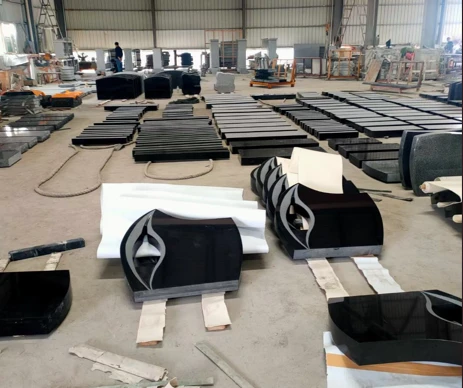
Installation: A professional installation team will install it from inside to outside and from bottom to top to ensure that the tombstone is stable and flat. Clean the site after installation.
7. Post-maintenance
Cleaning and maintenance: Clean the tombstone regularly to remove dust and stains to avoid long-term exposure to harsh environments that may cause weathering.
Inspection and repair: Regularly check whether the tombstone has cracks, looseness, etc., and repair it in time.