

For large commercial stair systems, granite treads must be specified as structural stone components rather than simple cut-to-size slabs. The procurement specification should control flexural strength, thickness tolerance, edge geometry, anti-slip treatment, surface finish, dimensional repeatability and packing, with project testing referenced to standards such as ASTM C97 and ASTM C880 where applicable.
The practical objective is straightforward: the factory should deliver finished treads and risers that can be installed directly against the approved shop drawings, minimizing field cutting, edge rework and dimensional correction.
Edge Profiles and Anti-Slip Grooving: 20–30 mm Groove Layout and Factory Control
Full Bullnose and Half Bullnose: 20–50 mm Edge Geometry
Edge treatment affects both appearance and impact resistance at the leading edge of a stair tread.
For commercial stair fabrication, common profiles include:
| Edge Profile | Typical Application | Fabrication Consideration | Recommended Control |
|---|---|---|---|
| Full Bullnose | Public stairs, hotels, commercial interiors | Continuous rounded edge | Radius must remain consistent across production lots |
| Half Bullnose | Exterior and institutional stairs | Rounded front edge with flat underside | Suitable where the tread bears on a supporting substrate |
| Pencil Edge | Interior circulation stairs | Small eased edge | Useful where a low-profile edge is required |
| Square Edge | Modern commercial stairs | Simple 90° geometry | Requires accurate corner finishing |
| Double Bullnose | Visible two-sided stair edges | Higher fabrication load | Confirm support and installation details |
A factory drawing should define the finished nose radius rather than relying on verbal descriptions such as "rounded edge."
For a 30 mm tread, the edge profile should be coordinated with the remaining structural section. Excessive edge removal can reduce the effective cross-section near the tread nose, particularly where the stone projects beyond its support.
For a 50 mm tread, larger edge profiles can generally be accommodated, but the actual allowable profile remains dependent on the stone type, support arrangement and structural calculation.
Anti-Slip Grooves: 2–3 Cuts with 10–20 mm Setback
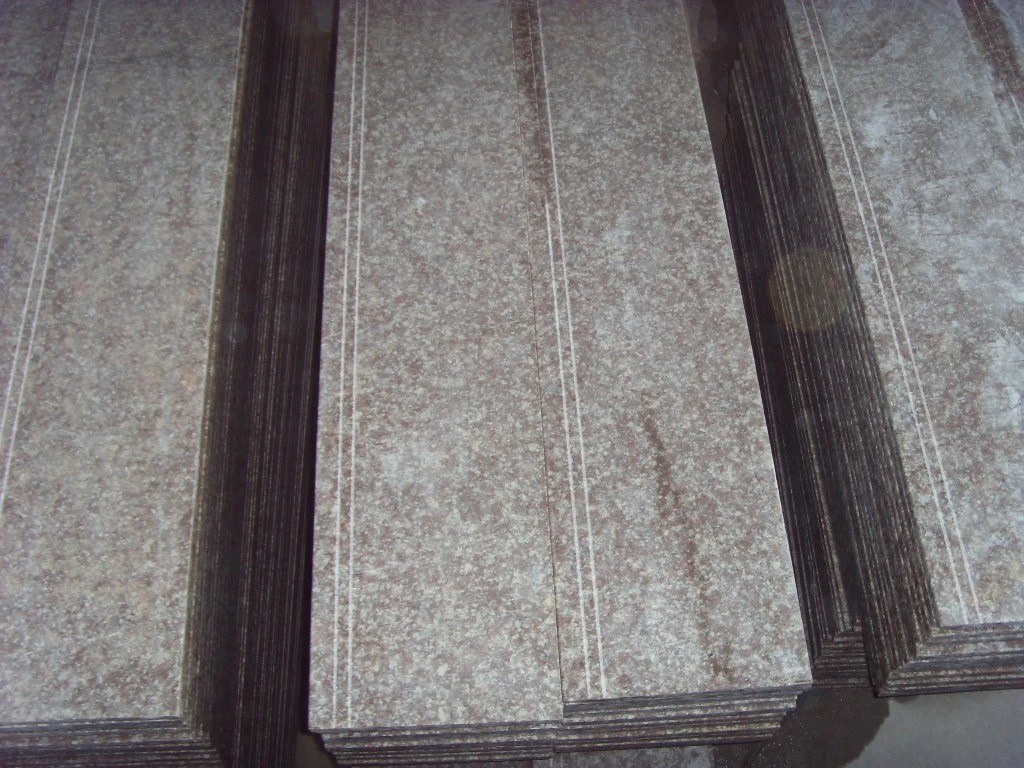
Factory-cut anti-slip grooves are preferable to uncontrolled site routing when hundreds or thousands of identical treads are required.
A typical commercial configuration can use 2–3 parallel grooves near the leading edge. The final groove width, depth and setback should be defined on the shop drawing according to the project's slip-resistance specification.
For applications requiring a bonded abrasive insert, the production sequence can include:
CNC or saw-cut groove formation.
Removal of stone dust and loose particles.
Dry inspection of groove dimensions.
Epoxy application.
Filling with calibrated silicon-carbide or similar abrasive aggregate.
Curing under controlled conditions.
Final surface inspection.
The groove geometry should not be treated as a decorative detail. Excessive groove depth reduces the local stone section, while insufficient depth can produce poor mechanical retention of the abrasive material.
Flamed, Bush-Hammered and Honed Finishes: ASTM C241/C1353 Verification
Surface finish must be selected according to the stair's exposure and required slip-resistance performance.
| Finish | Surface Characteristics | Typical Stair Use | Procurement Check |
|---|---|---|---|
| Flamed | Thermally textured surface | Exterior stairs and entrances | Surface consistency and color variation |
| Bush-hammered | Mechanically textured | Exterior steps, landscape stairs | Texture depth and uniformity |
| Honed | Low-reflectance smooth surface | Interior stairs | Slip-resistance requirement must be separately verified |
| Polished | High-reflectance surface | Decorative interior areas | Usually requires additional slip-performance consideration |
Slip resistance should be specified through the applicable project testing method rather than assumed from the finish name alone. Where ASTM testing is required, the buyer should identify the exact test method and acceptance value in the technical specification.
Need repeatable groove geometry across thousands of commercial stair treads?
Request Stair Tread Fabrication Details
Stress Distribution and Thickness Calibration: 30–50 mm Treads Under Project Loads
30 mm vs. 50 mm Granite Treads: Support Span and Flexural Strength
Granite tread thickness cannot be selected independently from the support condition.
A 30 mm tread supported continuously or over a short span behaves differently from a 30 mm tread projecting from a steel stringer. For exterior cantilevered stairs, structural engineers should calculate bending stress using the actual span, support width, stone flexural strength, live load, concentrated load and safety factors specified by the project.
A 50 mm tread provides a substantially greater section depth. For a simplified rectangular section, bending stiffness is strongly influenced by thickness because the section moment of inertia varies approximately with the cube of thickness.
For example, assuming identical width:
30 mm section: relative thickness factor = 30³
50 mm section: relative thickness factor = 50³
50 mm / 30 mm stiffness-related section ratio ≈ 4.63
This does not mean a 50 mm granite tread automatically has 4.63 times the permissible load. Actual performance depends on stone properties, support geometry, anchorage, span and load distribution.
Flexural Strength: ASTM C880 and Project-Specific Test Reports
Granite is a natural material, so flexural strength varies by quarry source and stone type. Procurement should therefore avoid using a generic "granite strength" value for structural design.
For project approval, request laboratory data identifying:
Flexural strength.
Water absorption.
Bulk specific gravity.
Density.
Compressive strength where required.
Test direction where applicable.
Quarry/source identification.
Sample thickness.
Test standard and laboratory information.
ASTM C880 is commonly used for determining flexural strength of dimension stone. ASTM C97 covers absorption and bulk specific gravity. The specified acceptance values should come from the project engineer or applicable stone specification rather than being assumed from a supplier's catalogue.
Thickness Tolerance: ±1 mm for Calibrated Commercial Production

Thickness tolerance is particularly important where granite treads interface with steel stair frames, aluminum profiles, stone risers or prefabricated concrete structures.
For calibrated production, a project may specify a target such as:
Nominal thickness: 30 mm
Finished thickness tolerance: ±1 mm
or:
Nominal thickness: 50 mm
Finished thickness tolerance: ±1 mm
The tolerance must be measured at defined points using calibrated equipment. A factory should also record thickness measurements during production rather than checking only the final pieces.
For large orders, the inspection plan should establish:
First-piece approval.
In-process dimensional inspection.
Random batch inspection.
Final dimensional inspection.
Packing verification.
Factory CNC Fabrication at ±1 mm: Reducing Site Re-Work
Infrared Cutter and CNC Water-Jet Cutting: ±1 mm Dimensional Control
Large stair projects frequently contain hundreds of repeated tread and riser dimensions. Manual cutting at the installation site introduces cumulative dimensional variation and additional labor.
A controlled factory workflow can combine:
Blocks yard inspection and block selection.
Slab processing and visual grading.
Infrared cutter sizing for straight repetitive cuts.
CNC edge profiling.
CNC water-jet cutting for complex geometry, openings and special details.
Automatic or semi-automatic edge calibration.
Dry-lay inspection.
Final dimensional inspection.
Protective packing.
For repetitive rectangular treads, infrared cutting provides efficient straight-line production. CNC water-jet cutting becomes more useful where the stair design contains curved noses, irregular returns, LED channels, fixing holes or other non-standard geometry.
The production drawing should identify every finished dimension instead of relying on the raw slab size.
Dry-Lay Inspection: Pattern, Color and Edge Consistency

Natural granite can vary between blocks and even within the same quarry source. For large stair installations, dimensional inspection alone is insufficient.
A dry-lay inspection should be performed for representative production lots, especially when the project contains highly visible stair flights.
The inspection can verify:
Color range.
Grain direction.
Vein or mineral distribution.
Surface finish consistency.
Edge-profile continuity.
Groove alignment.
Thickness.
Length and width.
Corner geometry.
Piece numbering.
Where the architectural design requires directional continuity, the factory should establish a piece-numbering system before production.
For visually directional granite, book-matching may also be required for adjacent architectural elements, although conventional stair treads usually prioritize consistent grain direction rather than mirror symmetry.
[💡 CTA Block]
Hook:
Reduce installation delays by receiving numbered, calibrated stair components from the factory.
Seaworthy Packing and Container Loading: 20–50 mm Stone Protection
Seaworthy Wooden Crates: Preventing Edge and Surface Damage
Finished stair treads are vulnerable to corner impact during loading, transshipment and unloading. The risk increases when a container contains hundreds of individually fabricated pieces.
A proper seaworthy wooden crates packing system should provide:
Internal separation between finished pieces.
Edge protection.
Anti-abrasion material between polished or honed surfaces.
Moisture-resistant protection where required.
Stable vertical or engineered horizontal loading.
Clearly visible crate identification.
Piece numbers corresponding to the packing list.
Weight and dimensional information for each crate.
Wood packaging for international shipment should comply with the applicable phytosanitary requirements, such as ISPM 15 where required by the destination country.
Container Weight Planning: Stone Density and Crate Weight

Granite commonly has a density around 2.6–2.8 tonnes/m³, although the actual value should be taken from the tested material.
A simplified calculation for a 30 mm slab is:
1 m² × 0.03 m × 2,700 kg/m³ ≈ 81 kg/m²
For 50 mm stone:
1 m² × 0.05 m × 2,700 kg/m³ ≈ 135 kg/m²
These figures exclude crates, packing materials and steel supports.
Therefore, container planning should be based on the actual finished-piece schedule rather than simply dividing the container's nominal payload by granite density. The shipper must also verify the carrier's maximum gross weight, road restrictions and destination-country regulations.
Factory-to-Site Quality Chain: ISO 9001 Records and ASTM Test Documentation
Quarry Block Selection: Source Consistency Before Cutting
A large stair order should begin with block selection rather than after slab production has started.
The factory should identify the production block or blocks used for the project and maintain traceability through:
Blocks yard → Block number → Slab production → Cutting → Edge processing → Inspection → Crating
This is particularly important for projects requiring a narrow color range.
Where a project specifies non-dyed absolute black granite, the buyer should verify that the material is naturally black and request confirmation regarding resin treatment, dyeing and surface enhancement.
A written material specification should state whether resin treatment, color enhancement or other treatments are permitted.
Inspection Documents: ASTM C97, ASTM C880 and ISO 9001
A project procurement package can request the following documentation:
| Document / Control | Purpose | Typical Reference |
|---|---|---|
| Water absorption | Assess moisture absorption | ASTM C97 |
| Bulk specific gravity | Determine density-related properties | ASTM C97 |
| Flexural strength | Assess bending performance | ASTM C880 |
| Dimensional inspection | Verify finished geometry | Project specification |
| Thickness inspection | Verify calibration | Project specification |
| Surface inspection | Verify finish and defects | Approved sample |
| Packing inspection | Verify shipment condition | Packing specification |
| Factory quality system | Production process control | ISO 9001, where certified |
ISO 9001 certification demonstrates that a quality-management system is in place; it does not replace material testing or project-specific dimensional inspection.
Commercial Stair Procurement Specification: 30 mm, 50 mm and Custom Profiles
Project Purchase Order Data: Dimensions, Finish and Testing
A technically usable purchase order should contain more than the stone name and quantity.
At minimum, define:
Granite commercial name and geological/material identification where available.
Quarry/source.
Nominal thickness.
Finished thickness tolerance.
Finished length and width.
Edge profile and radius.
Anti-slip groove quantity and dimensions.
Surface finish.
Exposed-face requirements.
Corner treatment.
LED channel dimensions where applicable.
Fixing holes or mechanical details.
Piece numbering.
Dry-lay inspection requirement.
Approved reference sample.
Testing requirements.
Packing method.
Crate identification.
Shipping documentation.
This information converts a visual stone selection into a production-controlled component specification.
Stair Tread and Riser Coordination: 30–50 mm Stone with Matching Wall and Paving Elements
Where stair treads connect to external paving, the interface between materials should be resolved before production.
The tread nose, riser, landing and adjacent paving system need coordinated finished elevations. Differences in stone thickness, bedding depth and drainage slope can otherwise create site-level adjustment work.
For projects using granite paving around the stair, the same quarry source and finish should be considered where visual continuity is required. The paving specification should separately define thickness, load condition, bedding system and joint dimensions.
FAQ: Commercial Granite Stair Tread Procurement and Fabrication
Can granite stair treads be supplied with polished sides and exposed edges?
Yes. Factory fabrication can include polished, honed, flamed or other specified edge finishes on exposed sides. The purchase drawing should identify every exposed edge and define the required edge profile, finish and dimensional tolerance.
Can granite stair treads be machined with recessed LED lighting channels?
Yes. CNC equipment can machine recessed LED channels, cable openings and other specified details before shipment. Channel width, depth, corner radius and exact location should be provided in approved CAD drawings.
What is the minimum order quantity for mixed granite stair tread sizes?
Mixed-size production can be arranged for project orders, but the practical minimum depends on the stone type, fabrication complexity and production schedule. A detailed piece list allows the factory to calculate the workable quantity before quotation.